

7 surprising facts about red river hogs
Posted on: 22 July, 2026
Red river hogs are striking wild pigs, recognisable by the bold red, white and black markings that give them their name. In the wild, they’re found in the forests and swamps of central and west Africa, including in Cameroon and Equatorial Guinea, where we run conservation projects.
Read on for 7 things you might not know about red river hogs…
1 They live in large family groups
In the wild, red river hogs live in groups of up to 20 hogs known as ‘sounders’. A sounder is usually made up of a boar (a male hog), with multiple sows (females) and their young. The boar protects his group from predators, like leopards, lions, hyenas and pythons.
2 They’re excellent swimmers
As their name suggests, red river hogs often swim and wade through water. When wading, they hold their tails in the air to avoid getting them wet. They can even swim underwater, holding their breath for up to 15 seconds at a time. Entering water can be a tactic to avoid predators, including leopards, hyenas and pythons.
3 They forage for food…. constantly
Like domestic pigs, red river hogs spend most of their time foraging for food. Digging and snuffling along the forest floor, they eat a varied diet of plants, roots, bulbs, fruit and even small animals. At the zoo, their large natural habitat has plenty of plants and mud to forage in, and our keepers use enrichment feeders to keep the hogs' bodies and minds active!

4 They’re threatened by hunting
Like many wild pigs, red river hogs are hunted for meat in the wild. This is also true of the Visayan warty pig, one of the species we’re working to protect in the Philippines. Our conservation programme there is based on community engagement and creating alternative livelihoods for local people, to reduce the need to hunt wild pigs. Read more about our work in the Philippines here.
5 Their bold markings help them evade predators
It may seem counterintuitive, but red river hogs’ bold markings actually camouflage them, helping them to evade predators. Hogs’ red and black faces are framed by striking white markings. These contrasting markings are a type of camouflage called disruptive colouration. Like the striking patterns of tigers, leopards and cheetahs, the hogs' markings help to break up their outline and blend in with their habitat.

6 They use their ears to defend their territory
Red river hogs are very territorial. They mark their territories using scent glands on their faces and legs, as a warning sign to other hogs. When faced with a rival, researchers believe they use their large ears in displays of dominance, making themselves look bigger to rivals. When physical fights for dominance occur, male hogs fight with their tusks. They have two large warts on their snout, which protect their tusks during these fights.
7 Their piglets look like little humbugs
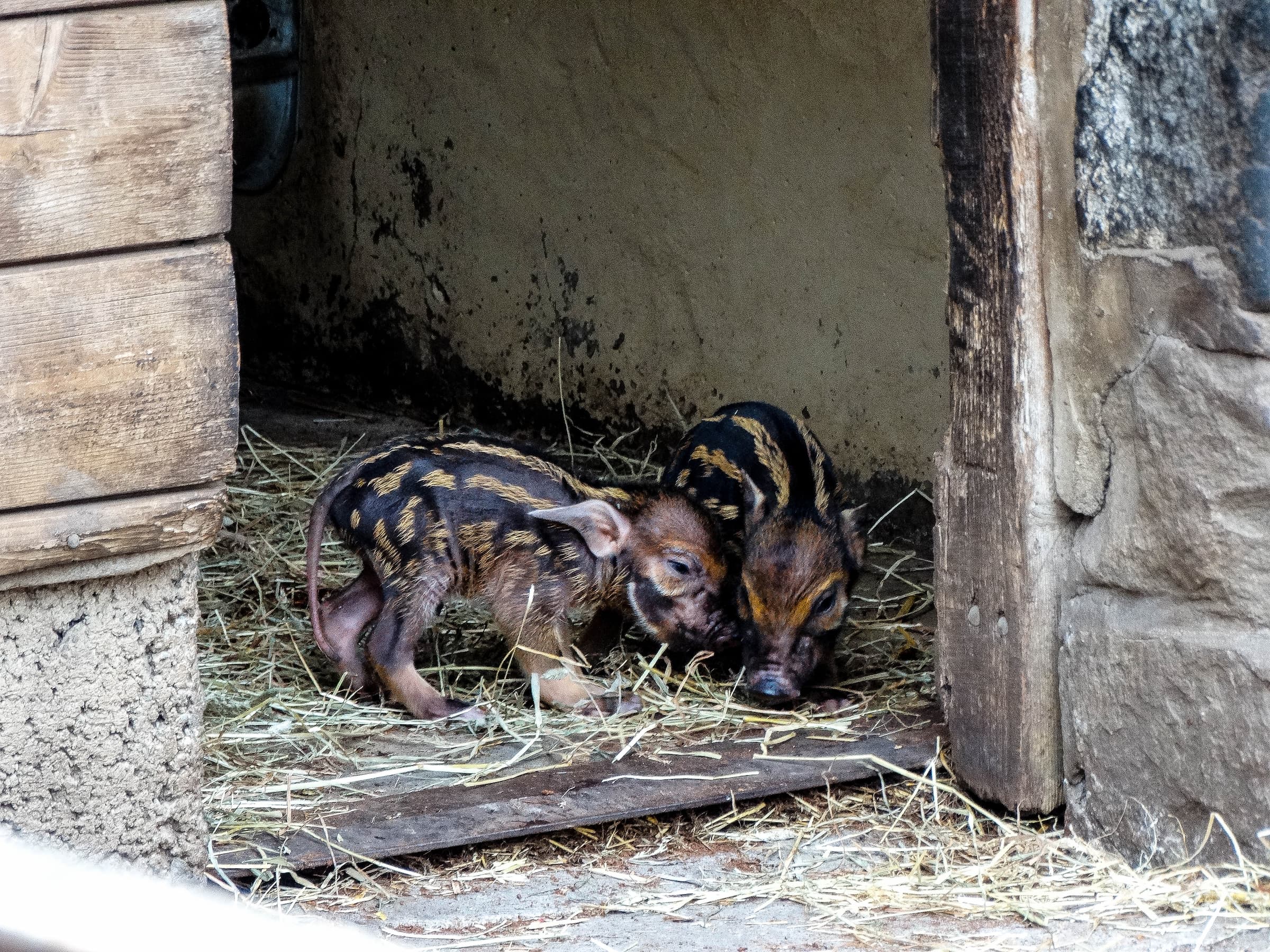
Red river hogs usually have three or four young at a time. The piglets are born with stripes, which fade as they grow and their adult colouring develops. In the same way their bold adult colouring works, the piglets’ stripes are another type of disruptive camouflage, helping to keep them safe from predators.
Visit our two red river hogs, Ekundu and Laña, in their large habitat near to the Walled Garden.
Bristol Zoo Project is run by Bristol Zoological Society, a conservation and education charity. Every visit supports our mission to protect nature now and into the future here in the UK and around the world.